How dual VPN technology works
A detailed overview of dual VPN technology in 2026. A simple explanation of how Double VPN works, what are its advantages over a regular VPN, and when is it really needed for maximum anonymity and data protection.
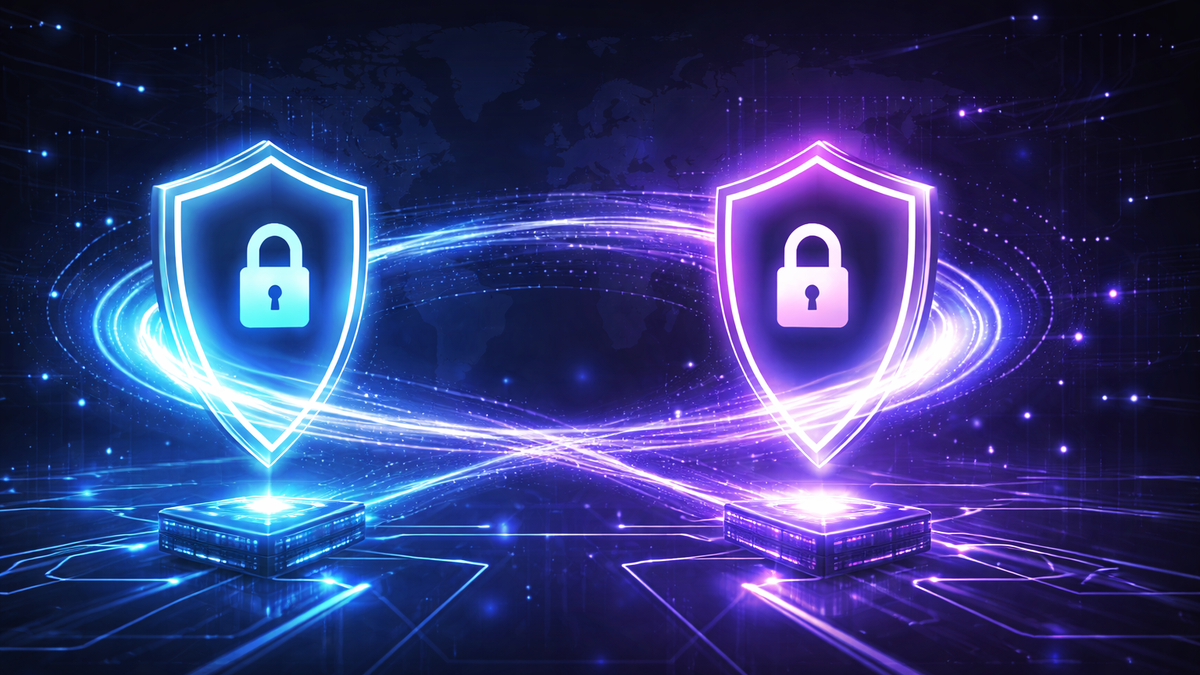
How double VPN technology works: a complete review 2026 for maximum anonymity and data protection
Double VPN (Double VPN, Multi-Hop VPN) is one of the most advanced anonymity and traffic protection technologies in 2026. It is used when a regular VPN is no longer enough: when working with confidential data, bypassing strict censorship, protecting from surveillance by the provider and third-party services.
In this 2026 review, we will look at how a double VPN works, how it differs from a regular VPN, in which cases it is really needed, and what to look for when choosing a VPN service that supports Double VPN.
What is a double VPN VPN)
Dual VPN is a technology in which your Internet traffic passes through not one, but two (or more) VPN servers in a row. Each server:
- encrypts traffic;
- replaces the IP address;
- adds an additional level of anonymity and protection.
Key features:
- two (or more) encrypted tunnels;
- two different IP addresses along the traffic path;
- routing traffic through different countries;
- complication de-anonymization and activity tracking.
How Double VPN technology works: step-by-step diagram
Let's consider how Double VPN works if you have a VPN client installed that supports “server → server” routes:
- Connecting to the first VPN server
- The client establishes an encrypted tunnel (for example, via WireGuard or OpenVPN).
- Your provider only sees the connection to the first VPN server, but not the end sites.
- Encryption and IP address spoofing
- The first server encrypts and forwards traffic to the second VPN server.
- Sites no longer see your real IP - only the IP of the first server.
- Transfer traffic to the second VPN server
- There is an additional encrypted tunnel between the servers.
- The provider does not see what resources you are accessing, and the first server does not explicitly know your final traffic.
- Decryption and access to the Internet from the second server
- The second server removes the outer layer of encryption and sends the request to the Internet.
- External sites and services they see the IP of the second VPN server - it becomes your “public” address.
- The response from the site is returned back along the chain
- The response first arrives at the second server.
- Then it is encryptedly sent to the first server.
- Then - to your VPN client, where it is finally decrypted.
B as a result:
- the provider sees only encrypted traffic to the first server;
- the first server knows your real IP, but does not see the final resource;
- the second server sees sites, but does not know your real IP;
- external resources see only the IP of the second VPN server.
Single VPN vs Double VPN: what is the difference
Regular VPN (Single VPN)
- One server.
- One layer of encryption.
- One public IP address.
- High speed, minimal delays.
- Enough for Wi-Fi protection, bypassing blocks, privacy for most scenarios.
Double VPN (Double VPN / Multi‑Hop VPN)
- Two or more servers in a row.
- Two levels of encryption and routing.
- Two different public IP addresses along the traffic path.
- Increased anonymity, complicated user tracking.
- Speed lower than a regular VPN, but secure above.
Why do you need a double VPN in 2026
Double VPN technology is in demand in 2026 in the following scenarios:
- Maximum anonymity and privacy
- It is more difficult to associate your actions with a real IP address.
- An additional level of protection from surveillance by the provider, network administrators and individual nodes.
- Protection against traffic correlation
- Distributing traffic across multiple nodes reduces the risk of timing and volume attacks when trying to correlate incoming and outgoing traffic.
- Bypassing strict censorship and blocking
- Combining servers in different countries helps bypass regional restrictions, national firewalls and blocking.
- You can build routes: a country with strict censorship → an intermediate country → a country with free access.
- Working with critical data
- Journalists, activists, IT specialists working with confidential corporate information.
- Protection of accounts, financial transactions, admin panels, corporate VPNs.
- Additional protection in public Wi-Fi networks
- Even if the access point is compromised and MITM attacks are attempted, it is much more difficult to decrypt the traffic.
Key advantages of a double VPN
- Enhanced anonymity and identity protection
- The IP address changes twice, path tracing becomes more complex.
- It is more difficult to investigate the real sources of traffic than with a classic VPN.
- Double traffic encryption
- An additional layer of encryption between VPN servers.
- Even if one node is compromised, it is more difficult for an attacker to gain access to all traffic.
- Protection against cross-network analysis and logging on one point
- There is no single point where both you and your traffic are visible.
- Separating information across nodes reduces the risks of deanonymization.
- Flexible routing by country
- You can select a chain of two countries: for example, “country A → country B.”
- Convenient for testing regional content, bypassing censorship and geo-restrictions.
- Compatible with modern VPN protocols
- Double VPN can be built on the basis of WireGuard, OpenVPN, IKEv2/IPsec.
- Supported on Windows, macOS, Linux, Android, iOS.
Disadvantages and limitations of Double VPN technology
- Reduced speed Internet connections
- Traffic passes through two servers instead of one.
- Latency (ping) increases and throughput decreases.
- Increased load on the device and network
- Additional encryption may require more CPU resources.
- Speed drops may occur on older devices.
- Not always needed for everyday use tasks
- For regular surfing, watching videos and social networks, one VPN server is often enough.
- Double VPN makes sense to enable when necessary.
- Requirement for the quality of the VPN provider's infrastructure
- If the servers are weak or overloaded, Double VPN will work slowly.
- You need a provider with a well-configured network and optimized routes.
What protocols are used in double VPN
In 2026, the following protocols are the most common for organizing Double VPN:
- WireGuard
- Modern, fast, with minimal delays.
- Ideal for building chains of servers and multihop routes.
- Uses modern algorithms: ChaCha20‑Poly1305.
- OpenVPN
- Classic protocol, widely supported.
- Can work over TCP/UDP, easily disguised as regular HTTPS traffic.
- Suitable for bypassing blocking and Deep Packet Inspection.
- IKEv2/IPsec
- Resistant to connection breaks, works well on mobile devices.
- Can be used as one of the layers in the Double VPN chain.
The best VPN services in 2026 offer a choice of protocols, as well as the ability to combine them when building routes.
Types of implementation of double VPN
1. Fixed chains of servers (preconfigured routes)
- The provider creates configurations in advance:
for example, “Server 1: Netherlands → Server 2: Switzerland.” - The user selects a ready-made route in the application.
- Pros: simplicity, stability, predictable performance.
- Cons: less flexibility in choice countries
2. Custom routes (custom chains)
- The user himself assembles the route: country 1 → country 2.
- You can select chains for your tasks (bypassing censorship, working with specific regions).
- Pros: maximum flexibility.
- Cons: requires more understanding of networks and how VPNs work.
3. Multi-Hop VPN with more than two servers
- Routes of 3 or more servers.
- Used for an extreme level of anonymity.
- In 2024, they are less common, as they cause a serious loss of speed and stability.
Double VPN vs TOP: what to choose for anonymity
Many users compare Double VPN with the Tor network. It is important to understand the differences.
Double VPN
- Managed by one VPN provider.
- Allows you to choose countries and servers.
- Better suited for stable access to websites, streaming, work.
- Gives a high level of protection, but with lower latency than Tor.
Tor
- Decentralized network voluntary nodes.
- Traffic passes through 3 or more random nodes.
- Maximum anonymous, but very slow.
- Many sites block traffic from Tor.
The optimal strategy for 2026is to use Double VPN for constant secure operation and anonymity, and Tor - only for specific tasks where extreme secrecy is important and not critical speed.
How to choose a VPN service with support for double VPN in 2024
When choosing a VPN provider for Double VPN, pay attention to:
- The presence of a built-in Double VPN / Multi-Hop function
- Support for double VPN directly in official applications.
- Simple activation in 1-2 clicks, without manual steps configurations.
- Speed and stability of servers
- High throughput.
- Optimized routes between countries.
- Minimum ping in multihop chains.
- Modern protocols and encryption
- WireGuard, OpenVPN, IKEv2/IPsec
- AES-256-GCM and ChaCha20-Poly1305 algorithms.
- Perfect Forward Secrecy support.
- Privacy policy and No-logs policy
- Transparent privacy policy.
- Minimum fee metadata.
- Independent security audits are preferable.
- Server geography and chain options
- Servers in Europe, USA, Asia, and other key regions.
- Ready “country → country” routes for different scenarios.
- Simple applications for all platforms
- Windows, macOS, Linux.
- Android, iOS.
- Ability to set up Double VPN on a router or NAS.
- Additional security features
- Kill Switch (automatically disconnects the connection when the VPN drops).
- DNS protection and own DNS servers.
- Blocking trackers, ads and malware sites.
How to enable and use double VPN in practice
Below is a universal scenario on how to use Double VPN through a modern VPN service.
- Install the official VPN service application
- Download the client for your OS (Windows, macOS, Linux, Android, iOS).
- Login using your account.
- Open the server selection section / Multi-Hop / Double VPN
- Find the tab with routed chains.
- Check out the available country pairs.
- Select the appropriate route
- For maximum anonymity - chains with neutral jurisdictions.
- To work with content - combinations with the desired countries (for example, “country A → USA”).
- Select the VPN protocol
- For speed - WireGuard.
- To bypass blocking - OpenVPN (TCP/443).
- For mobile devices - IKEv2/IPsec.
- Enable Kill Switch and DNS protection
- Block traffic when the VPN goes down.
- Use your provider’s DNS servers to avoid sending requests to your provider.
- Connect to the Double VPN route
- Click “Connect” and wait for the tunnel to be established.
- Check the IP address through any IP checker - the IP of the second server should be displayed.
- Check the speed and stability
- Open several sites, videos, VPN-dependent services.
- If necessary, change the route to a faster one.
For what tasks in 2026 Double VPN is especially recommended
- Work sessions for administrators and IT specialists.
- Access to banking services and crypto exchanges from countries with restrictions.
- Bypassing national censorship and blocking of news resources.
- Working with corporate email, CRM, internal portals from outside.
- Negotiations and exchange of documents with increased privacy.
- Journalists, human rights activists, researchers working in risk areas.
Practical tips for safe use of double VPN
- Enable Double VPN only where you really need it
- For regular streaming and online gaming, use a regular VPN for maximum speed.
- Enable Double VPN for sessions with high demands on anonymity.
- Use strong authentication
- A complex unique password for your account.
- Two-factor authentication (2FA, TOTP applications).
- Keep an eye on VPN client updates
- Update applications to the latest version.
- Receive the latest security patches and improvements speed.
- Enable auto-connection and Kill Switch
- So that traffic does not go to the Internet unprotected if the VPN is temporarily disabled.
- Combine Double VPN with HTTPS and secure services
- Even when using a VPN, it is important that sites work over HTTPS.
- Do not enter passwords and card details on suspicious ones resources.
Frequently asked questions about dual VPN in 2026
Double VPN makes me completely anonymous on the Internet?
No technology provides 100% anonymity. Double VPN significantly increases the level of protection and makes it difficult to track, but your habits, browser settings, and the absence of leaks through accounts and social networks are also important.
How much does the speed drop when using Double VPN?
Depends on the provider, the distance between servers and the quality of channels. On average, speeds can be reduced by 20-50% compared to a regular VPN. With the right infrastructure, the drop in speed remains comfortable for work and surfing.
Is it possible to use double VPN on a smartphone?
Yes, modern VPN applications for Android and iOS support Multi-Hop routes. It is important to consider the battery charge and choose a balance between security and speed.
Double VPN and a chain of three servers - which is better?
A chain of three servers theoretically gives a little more anonymity, but sharply reduces speed and stability. In 2026, Double VPN (2 servers) is considered to be the optimal speed/protection balance.
Does it make sense to use Double VPN together with a proxy?
In some cases, yes (for example, for specific tasks and additional obfuscation). But for most users, a properly configured Double VPN with a modern protocol is sufficient.
Results: why in 2026 it is worth using a VPN service with support for Double VPN
Double VPN is a technological standard for increased security and anonymity, which:
- Adds a second level of encryption and IP address spoofing;
- Complicates surveillance, analysis and correlation traffic;
- helps bypass censorship and blocking;
- protects when working with confidential and corporate data.
In 2024, the optimal strategy is to choose a professional VPN service with:
- Double VPN / Multi-Hop function,
- high server speed,
- transparent policy privacy,
- modern protocols (WireGuard, OpenVPN, IKEv2),
- convenient applications for all devices.
Using such a service, you get not just a standard VPN, but a full-fledged tool for safe, anonymous and stable work on the Internet - at home, in the office and on any public networks.
Related articles
You might also like
Как установить VPN на Android в 2026: пошаговая инструкция
Как установить VPN на Android в 2026: пошаговая инструкция Если YouTube грузится по три минуты, Ins...
Read moreVPN на айфон: настройка конфигурации в 2026
VPN на айфон: настройка конфигурации в 2026 Если вам прислали файл конфигурации или ссылку на VPN-с...
Read moreVPN для айфона с GitHub: бесплатные конфиги в 2026
VPN для айфона с GitHub: бесплатные конфиги в 2026 Если вы вбили в поиск «впн для айфон гитхаб», ск...
Read more