VPN for torrents: which services allow P2P
A detailed guide to choosing a VPN for torrenting in 2026. Which services really allow P2P, what functions are needed for anonymous and fast downloading, and how to set up a torrent client via VPN so as not to expose your IP and bypass tracker blocking.
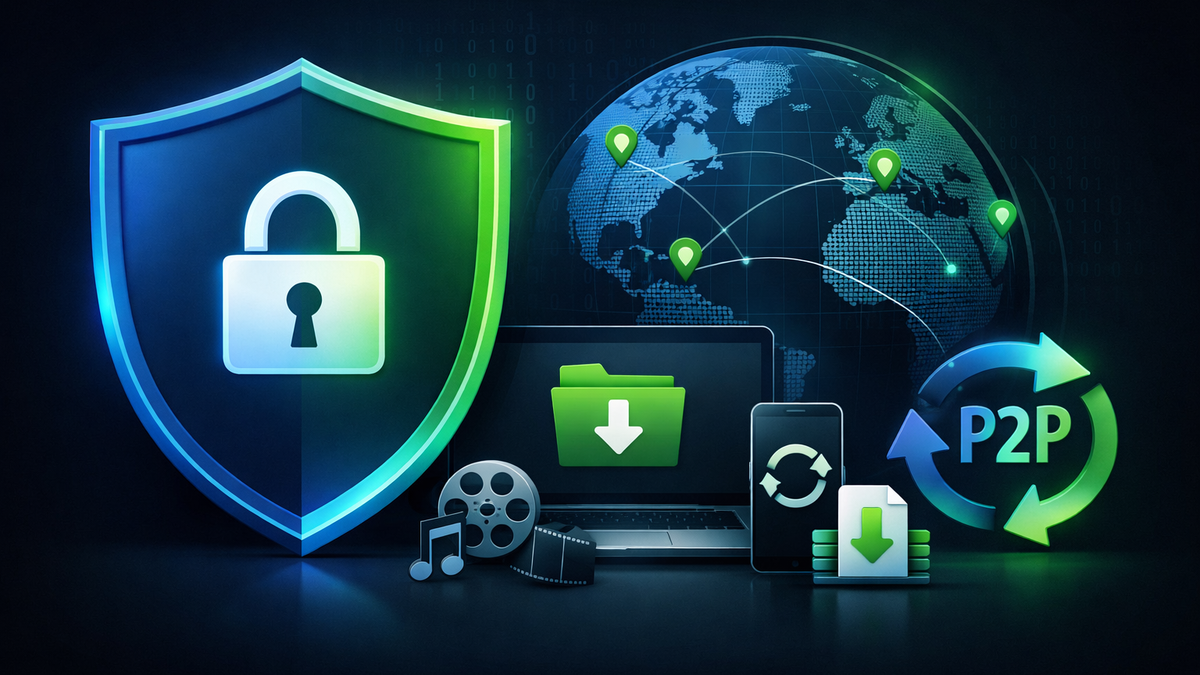
VPN for torrents: which services allow P2P - expert advice 2024
VPN for torrents (P2P VPN) is one of the most popular requests among users in 2026. People want to download torrents anonymously, without ISP surveillance, speed limits and the threat of blocking. But not every VPN service allows P2P traffic, and the wrong choice can lead to IP address leakage, warnings from the provider and security problems.
Below is the most practical and SEO-optimized guide: how to choose a VPN for torrents, which services allow P2P, what functions are needed for secure downloading and what mistakes users most often make.
Why do you need a VPN for torrents and P2P networks
When working with torrent clients (qBittorrent, uTorrent, Transmission, Deluge, etc.), all P2P traffic:
- is completely transparent to the provider;
- shows your real IP address to all distribution participants;
- can be logged by trackers and third parties observers;
- often artificially limited in speed (throttling, shaping).
VPN for torrents solves several problems at once:
- hides the real IP addressin the torrent royale;
- encrypts all traffic, making it invisible to the provider;
- bypasses blockingof torrent sites and trackers;
- protects against throttlingand speed limits using P2P protocols.
Which VPN services allow P2P traffic
Conventionally, VPN providers can be divided into three groups:
- VPN with full support for torrents (P2P allowed)
- Explicitly allow P2P traffic in the usage policy.
- Have special P2P servers or a “P2P” mark in the list of locations.
- Do not limit speed and do not cut torrents.
- Partially allowing P2P (limited locations)
- Torrents are allowed only on certain servers and in certain countries.
- On other servers, P2P is blocked or severely reduced.
- Completely prohibiting torrents (No P2P)
- Banning P2P traffic in the terms of use.
- Filtering or automatically blocking BitTorrent connections.
When choosing a VPN for torrents, it is important to immediately check:
whether the service supports P2P, on which servers and in which countries.
What to look for when choosing a VPN for torrents
1. Strict no-logs policy
The key criterion is the absence of logs by which your activity can be tracked:
- the service does not store the history of visited sites;
- does not record P2P connections and IP addresses of sources;
- collects a minimum of technical data (and clearly describes this in the privacy policy);
- an independent audit of the policy is desirable no‑logs.
2. Allowed P2P traffic on servers
It is important that:
- in the documentation and on the website there was direct mention of torrent support;
- the applications had separate P2P servers (labeled P2P or Torrent);
- there was no hidden ban on the use of BitTorrent.
If the service “hides” information about P2P or the rules have a general ban on copyrighted materials, but torrents are not technically blocked, this is a zone risk.
3. High speed and stability
For comfortable downloading and distribution of torrents, a VPN must provide:
- support for modern protocols (WireGuard, OpenVPN, IKEv2);
- a wide network of servers with gigabit channels;
- the absence of strict limits on speed and traffic;
- minimal ping up to P2P servers.
4. Kill Switch function
Kill Switch is a mandatory option for VPN for torrents:
- if the VPN connection suddenly breaks down, Kill Switch blocks all Internet traffic;
- the torrent client will not “fall out” onto the network with the real IP address;
- protection works at the OS level (Windows/macOS/Linux/Android).
When using VPN for P2P, Kill Switch must always be enabled.
5. Protection against IP and DNS leaks
A reliable VPN for torrents must:
- protect against DNS leak protection;
- disable/redirect IPv6 (taking into account possible leaks);
- minimize WebRTC leaks in browsers;
- use your own DNS servers.
Without this, your real IP may be visible even with an active VPN tunnel.
6. Possibility of port forwarding (optional)
For maximum speed of distributing and receiving torrents, port forwarding is useful:
- VPN service allocates an open port for you;
- the torrent client can accept incoming connections;
- increases the number of active peers and download speed.
Not all VPN services support port forwarding, but for This is an important feature for advanced users.
Which VPN protocols are better for torrents
WireGuard
- maximum speed;
- minimum delays;
- modern encryption (ChaCha20‑Poly1305);
- ideal for constant operation of a torrent on background.
OpenVPN
- classic, reliable protocol;
- works well with bypassing blocking;
- slightly slower than WireGuard, but more universal.
IKEv2/IPsec
- resistant to connection breaks;
- convenient on mobile devices;
- suitable if you download torrents from a phone or tablet.
The best option is a VPN service that supports all three protocols and allows you to select them in the settings.
How to set up a VPN for torrents: step-by-step instructions
Step 1. Select a VPN service with P2P support
Focus on:
- availability P2P servers;
- no-logs policy;
- positive reviews about speed and stability;
- support for the platforms you need (Windows, macOS, Linux, Android, iOS, routers).
Step 2. Install the VPN application
- Download the official client from the provider’s website or from the app store.
- Install on the computer/laptop where the torrent client is running.
- Log in to the application.
Step 3. Enable security features
- Activate Kill Switch.
- Enable protection against DNS leaks.
- If necessary, block IPv6.
- Enable VPN autostart at system startup.
Step 4. Connect to a P2P server
- Open the list of servers in the VPN client.
- Select a location marked P2P/Torrent or country where torrents are allowed.
- Connect and wait for the tunnel to be established.
Step 5. Check the change in IP address
- Go to any IP checker or specialized torrent IP checker.
- Make sure that the IP address of the VPN server is displayed, and not yours real.
Step 6. Set up a torrent client
- Launch qBittorrent, uTorrent, Transmission or another client.
- If necessary, specify the port allocated to the VPN (if you use port forwarding).
- Enable encryption at the client level (if there is an option).
Step 7. Start downloading and distribution
- Add the required .torrent file or magnet link.
- Control the speed of downloading and sharing.
- Make sure that the VPN remains connected throughout the session.
Which VPN functions are especially important for torrents
- Allowed P2P traffic
Without direct P2P permission, using a VPN for torrents may violate the rules of the service. - High speed on P2P servers
Gigabit channels, modern protocols, no heavy loading. - Kill Switch + leak protection
Required elements for anonymous downloading and distribution. - No-logs policy
Minimizes the risks associated with storing connection history. - Port forwarding (if you need maximum speed)
Allows you to achieve a better seed/leach ratio and increase speed. - Support for torrents on all platforms
Convenient if you download and distribute torrents from different devices.
Typical mistakes when using a VPN for torrents
- Launch torrents before the VPN is connected
The client manages to “highlight” your real IP on the tracker and in the piano. - Disabling VPN during active downloads
After the tunnel is broken, the torrent continues to work directly. - Using a VPN without Kill Switch
If there are temporary connection problems, short periods without protection are possible. - Selecting a server where P2P is prohibited
VPN can limit or block traffic, reducing speed and creating risks. - Ignoring DNS and IPv6 leaks
Even with an active VPN, some requests may bypass the tunnel.
The legality of using VPNs and torrents
It is important to separate two aspects:
- VPN as a technologyis legal in most countries - it is a tool for protecting traffic and privacy.
- Torrents as a P2P protocolare also not prohibited in themselves - many projects distribute legal content through them (Linux distributions, games, movies with an open license).
Problems arise when downloading and distributing materials protected by copyright, bypassing the law of a particular country.
Responsibility for the contents of downloaded files always remains with the user.
VPN on a router for torrents
For those who download torrents from several devices or from home NAS servers, it is convenient to set up a VPN on the router:
- all P2P traffic goes through the VPN tunnel;
- no need to configure VPN on each device separately;
- convenient for media servers (Plex, Jellyfin) and torrent boxes.
To do this:
- Make sure that The router supports OpenVPN/WireGuard/IKEv2.
- Install VPN-compatible firmware (if needed).
- Import the P2P server configuration from the provider.
- Enable routing of all traffic through the VPN or do selective routing for torrenting devices.
Expert answers to frequently asked questions about VPN for torrenting
Can I use a free VPN for torrenting?
Not recommended. Free VPNs often:
- prohibit P2P traffic in the rules;
- reduce speed to a minimum;
- log traffic and IP addresses;
- can transfer data to third parties.
For torrents, it is better to use a reliable paid VPN service.
Will the provider see that I am downloading torrents via VPN?
When configured correctly:
- the provider sees only encrypted VPN traffic;
- does not see which protocols you are using inside the tunnel;
- cannot see the contents of torrents and the list of files.
Can a torrent tracker see my real IP address?
If the VPN is connected, it is protected from leaks, Kill Switch is enabled and torrents are launched only after a VPN connection is established, the tracker will only see the IP address of the VPN server.
Do I need to enable VPN if I download only legal files?
Recommended. Even legal torrents:
- reveal your real IP address to all members of the royal;
- allow the provider to log what files you download;
- can be used for behavior analysis and targeting.
Does a VPN affect the speed of torrents?
Yes, but with the right choice of service and server:
- a drop in speed minimal;
- you can even get a win if the provider limited P2P traffic.
Results: which VPN is better for torrenting in 2026
A reliable VPN for torrenting in 2024 should:
- officially allow P2P traffic and have P2P servers;
- adhere to a strict no-logs policy;
- provide high speeds on WireGuard/OpenVPN;
- have Kill Switch and protection against DNS/IPv6 leaks;
- support port forwarding if necessary;
- work on all your devices and, if possible, on the router.
Using such a VPN service, you:
- hide the real IP address in torrent networks;
- protect traffic from your provider and outside observers;
- bypass blocking of trackers and torrent sites;
- get stable download and upload speeds.
VPN for torrents is not only about access to files, but also about privacy, security and control over your Internet traffic. The right P2P‑VPN turns downloading and sharing torrents into a safe and comfortable process, without unnecessary risks and restrictions.
Gallery




Related articles
You might also like
Как установить VPN на Android в 2026: пошаговая инструкция
Как установить VPN на Android в 2026: пошаговая инструкция Если YouTube грузится по три минуты, Ins...
Read moreVPN на айфон: настройка конфигурации в 2026
VPN на айфон: настройка конфигурации в 2026 Если вам прислали файл конфигурации или ссылку на VPN-с...
Read moreVPN для айфона с GitHub: бесплатные конфиги в 2026
VPN для айфона с GitHub: бесплатные конфиги в 2026 Если вы вбили в поиск «впн для айфон гитхаб», ск...
Read more